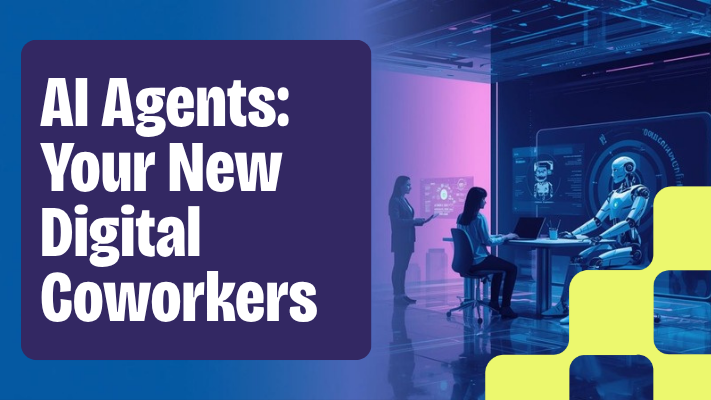
If you’ve been following technology news in 2026, one term keeps surfacing again and again: agentic AI. Unlike the chatbots and AI assistants of the past, AI agents don’t simply answer questions — they autonomously plan, act, and adapt to get work done. In short, they’re becoming digital coworkers, and the transformation is happening faster than most people anticipated.
From drafting emails and managing schedules to executing complex multi-step business workflows, AI agents are reshaping what it means to work alongside technology. Whether you’re an entrepreneur, a professional, or simply curious about where tech is heading, understanding this shift is crucial in 2026.
What Are AI Agents — and Why Are They Different?
Traditional AI tools react to prompts. You ask a question, you get an answer. AI agents, on the other hand, operate autonomously toward defined goals. They plan multistep actions, use tools (like browsing the web, writing code, or managing files), and adapt when circumstances change — all without constant human direction.
Think of the difference this way: a traditional AI assistant is like a very smart search engine. An AI agent is more like a capable junior employee who can take a project brief and figure out how to complete it, step by step, on their own.
According to MIT Sloan, agentic AI systems are defined by their ability to set subgoals, decide on actions, and execute them iteratively — a fundamental departure from reactive AI models. This gives them the power to tackle ambiguous, complex tasks that previously required sustained human attention.
The Numbers: AI Agents Are Already Everywhere
The growth trajectory of AI agents is staggering. The global AI agent market reached $7.6 billion in 2025 and is projected to exceed $50 billion by 2030, according to market analysts — representing a compound annual growth rate of over 40%. More bullish projections suggest the sector could reach $236 billion by 2034.
Enterprise adoption is accelerating rapidly. Research shows that while less than 5% of enterprise applications featured AI agents in 2025, that figure is projected to hit 40% by the end of 2026. Some forecasts put it even higher, with 80% of enterprise apps eventually embedding agents.
But there’s a critical gap between enthusiasm and execution: while nearly 80% of enterprises have adopted AI agents in some form, only about 1 in 9 currently runs them in production. This adoption-to-production gap represents both a challenge and an enormous opportunity for businesses willing to lead.
What AI Agents Can Actually Do in 2026
So what does having an AI agent as a digital coworker look like in practice? Here are the most impactful use cases emerging this year:
Customer Service & Support: AI agents can handle entire customer conversations, escalate when needed, access databases, process refunds, and follow up — all autonomously. Customer service and eCommerce are currently leading adoption because the ROI is clear and measurable.
Research and Analysis: Agents can be tasked with researching a market, synthesizing multiple sources, and delivering a structured report — work that used to take an analyst hours or days. This is particularly powerful for finance and insurance professionals who need rapid, data-driven insights.
Software Development: Coding agents are already showing measurable impact. One study found that weekly code merges rose by approximately 39% after a coding agent became the default generation mode for a development team.
Administrative and Workflow Automation: From scheduling meetings to processing invoices and routing documents, AI agents are handling the procedural tasks that eat up hours of human time each week. Studies report up to 30% productivity gains in teams that effectively deploy AI agents for these functions.
Healthcare Coordination: In health and wellness, AI agents are beginning to manage patient intake, monitor health data from wearables, and coordinate care pathways — with appropriate human oversight at critical decision points.
How to Successfully Work With AI Agents
Deploying AI agents effectively requires more than just turning them on. Based on best practices from IBM, Deloitte, and McKinsey, here’s what actually works:
Start with structured, high-impact tasks. AI agents excel where work has a clear beginning, middle, and end. Don’t start with vague creative tasks — begin with well-defined workflows like data processing, report generation, or customer inquiry routing.
Prioritize data quality. Research consistently shows that 80% of the effort in agentic AI projects goes into data engineering, stakeholder alignment, and workflow integration — not the AI itself. Clean, structured data is the foundation everything else is built on.
Maintain meaningful human oversight. The most successful implementations include permission systems that define which actions agents can take autonomously versus which require approval. Setting confidence thresholds — where the agent pauses and asks for human review when uncertain — dramatically reduces errors.
Measure what matters. Define KPIs before deploying agents: accuracy rates (target ≥95%), task completion rates (target ≥90%), and business impact metrics like cost savings and time reclaimed. Without measurement, it’s nearly impossible to improve.
Design for collaboration, not replacement. Companies seeing the best results treat AI agents as team members with complementary strengths. Research found that agents designed with personalities that complement human colleagues achieved better productivity and teamwork outcomes.
The Risks You Need to Know
Not everything about AI agents is smooth sailing. Gartner has forecast that more than 40% of agent projects will fail by 2027 — primarily due to governance gaps, poor observability, and unclear ROI expectations. Organizations that rush deployment without proper oversight structures are especially vulnerable.
Security is another concern. Autonomous agents that have access to email, files, calendars, and external APIs create new attack surfaces. Malicious actors can attempt to manipulate agent behavior through crafted inputs — a technique called prompt injection. Building robust guardrails is not optional.
And then there’s the workforce dimension. While AI agents handle routine procedural work, the demand for human skills around agent management, oversight, and higher-order decision-making is growing. The professionals who learn to work with AI agents — rather than competing against them — will have a significant advantage in 2026 and beyond.
Conclusion: Your Digital Coworker Has Arrived
The age of AI agents as digital coworkers isn’t a concept locked in a research paper — it’s unfolding right now, across industries and organizations of all sizes. The companies and individuals who understand how to harness agentic AI will move faster, accomplish more, and deliver better results than those who don’t.
Here are the key takeaways:
- AI agents are autonomous, goal-directed systems — a fundamental upgrade from reactive AI tools.
- The market is growing at 40%+ CAGR, with enterprise adoption accelerating sharply in 2026.
- Productivity gains of up to 30% are achievable when agents are deployed on well-structured tasks.
- Success requires data quality, human oversight, and clear KPIs — not just good technology.
- The biggest risk is moving too fast without governance. The second biggest risk is moving too slow.
Whether you’re a business owner exploring automation, a professional looking to stay ahead, or simply someone trying to understand where the world of work is heading — 2026 is the year to get serious about AI agents. Your digital coworker is ready. Are you?
Stay ahead of the curve with SmartReviewsLab.com — your trusted source for tech reviews, tool recommendations, and digital productivity insights.